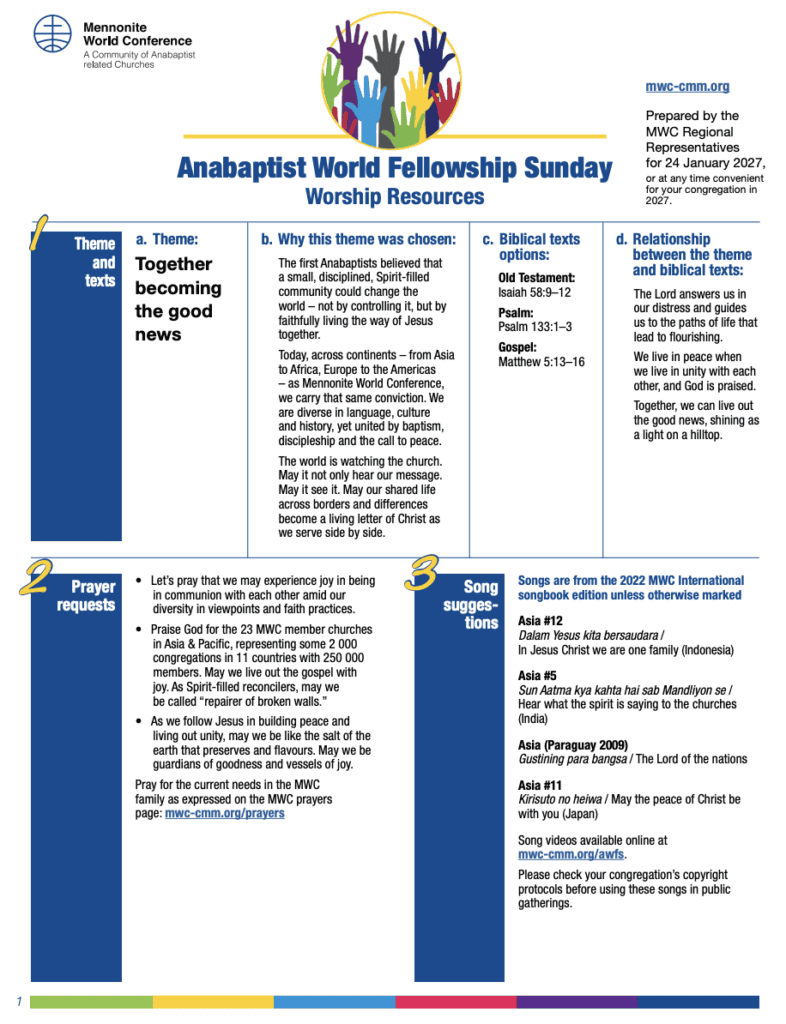
Anabaptist World Fellowship Sunday 2027
A channel for God’s grace
Isaiah 58:9-12
“When you pray, I will answer you. When you call to me, I will respond” (Isaiah 58:9). What a great promise that our prayers are answered, that our calls have response from God!
When I was 17 years old, I was diagnosed with trigeminal neuralgia. I felt a sharp, stabbing and burning pain in my left face. I felt hopeless because the doctor said it is a chronic disease.
Out of desperation, my parents brought me to many hospitals and even to less reputable doctors fraudulently claiming expertise. And those failed to heal me.
That situation led me to drop my knees in prayer and ask God for a miracle. After one and a half years of begging for God’s healing, it finally came on 8 February 2002 during our prayer gathering. In an instant, I felt a menthol-like energy running on my surrendered hands. I had been earnestly seeking God’s healing and God answered!
From then on, I knew God has called me to serve in God’s vineyard. The darkness around me turned to the brightness of noon.
God asks us to first clear the debris of our own cruelty, judgment and malice before the channel of communication is fully open. Offering tangible help to the hungry and those who are in need makes us to be God’s instrument of blessings to others.
On the other hand, we feel sad and weak when there are no results yet on the work entrusted to us. But when we live a life of active compassion, we are not left emptied. Instead, God promises guidance, strength and deep satisfaction.
The imagery used in Isaiah 58 is brilliant: a well-watered garden and a spring that never fails.
When we become a channel for God’s grace to reach others, that living water must first flow through us, keeping our own souls vibrant and alive.
Finally, verse 12 tells us about our legacy to the next generation. When we live out this blueprint of justice and mercy, we become architects of restoration.
We live in a world full of broken relationships, fractured communities and systemic injustices. When we align our hearts with the vulnerable, we find that God was waiting for us there all along.
This passage calls us to be the people who rebuild on sturdy foundations. Our acts of kindness do not just patch temporary holes; they restore the very walls and houses of society, creating safe spaces for future generations to dwell.
Felipe R. Magbuhos Jr. is Integrated Mennonite Churches (IMC) Education Committee chair and associate pastor, Lacao Mennonite Bible Church, Philippines. He delivered this reflection at Renewal 2026 in the Philippines.
Abundant spiritual life
Psalm 133:1
Psalm 133 is a psalm of King David, one of the Psalms of Ascents. The Psalms of Ascents are sung by pilgrims on their journey to the holy temple, encouraging one another along the way.
In its short three verses, the psalm uses two images to depict the central theme of the first verse: community harmony and fellowship.
The first image is Aaron the priest being anointed with precious oil. The second image is Mount Hermon and Mount Zion.
Anointing oil
The precious oil poured on Aaron’s head is at the solemn and important moment when Aaron, as High Priest, is anointed. As High Priest, Aaron’s work was to pray, confess sins and bless all the people of Israel. In other words, he stood between God and the people. When people sinned, they would come to Aaron to pray for them, to bridge the gap between them and God.
We Mennonites believe that we can confess our sins to one another, just as Martin Luther would seek out his monastery brothers to confess to one another. Indeed.
Behold, how good and pleasant it is when brothers dwell in peace! What God desires is peaceful coexistence among brothers and sisters.
When God gave the Ten Commandments to the Israelites, it wasn’t just about the relationship between people and God; more than half of them concerned the relationship between God’s people.
The psalm says the oil went down to the skirts of Aaron’s garments. What was on Aaron’s hem? There was a breastplate with 12 different gemstones, each representing the 12 tribes of Israel. That means that the precious oil poured on Aaron’s head, flowing down to his beard, to the 12 tribes of Israel, and then to all of God’s people.
How does Jesus describe our relationship with God’s people, the relationship with our brothers and sisters?
Mount Hermon and Mount Zion
Psalm 133:3 is a beautiful picture: Mount Hermon in the distance, its dew falling on Mount Zion, nourishing the earth and filling it with life.
Mount Hermon is located at the southern end of the Anti-Lebanon Mountains, more than over 2 800 meters high. Its peak is covered in snow year-round, and the mountain range has abundant rainfall. Mount Zion, on the other hand, is lower, only 765 meters high, and is a drier mountain. If you look at a map, the two mountains are actually quite far apart (almost 300 kilometres).
Mount Hermon was the highest mountain in the Promised Land that Joshua conquered. Water flowed down from it, first passing the Sea of Galilee, then the Jordan River, and finally into the Dead Sea to the south. The main springs of the entire Promised Land originated from Mount Hermon.
Mount Hermon is now Israel’s only ski resort area. Moist air from the Mediterranean rises as it encounters Mount Hermon, and combined with the northerly winds, it carries the cold, icy air to Jerusalem in the south. Therefore, Psalm 133 records, “The dew of Hermon fell on Zion.”
For the Israelites, they hoped the dew of Mount Hermon would share its sweetness with the mountains of Zion.
For us, pastors, small group leaders/mentors, please remember: you are Mount Hermon to your small group members and church members. They desperately need nourishment from you. God calls you to their side so that you may share some of the grace you have received from God with them.
Are our spiritual lives abundant? If we ourselves are parched, how can we become someone else’s Mount Hermon?
Most importantly, some times we are Mount Hermon, and at other times we are Mount Zion.
May God bless us.
By Jeremiah Choi, Hong Kong
Lessons from “the miracle house”
The Nepal “miracle house” footage is one of the most viral videos of the day. A catastrophic flood triggered by a glacial collapse on 26 August 2026 swept away homes, roads, bridges, vehicle and entire sections of villages in Nepal.
As of 4 September 2026, according to Nepal’s National Disaster Risk Reduction and Management authority, more than 1 250 people were reported dead, 42 000 missing, and around 20 000 homes needing reconstruction, including at least 7 500 completely destroyed.
This one green house still standing amid devastating devastation is striking. When the flood came and the torrent of water and the debris slammed against the house, it stood firm.
Why?
According to the experts, before anyone claims exactly why it survived, the house deserves a proper structural and geotechnical investigation. However, few highly possible reasons have been highlighted so far.
Untraditional
The “miracle house” in Nuwakot, Nepal, was built using a frame skeleton, while neighbouring houses relied on gravity, heavy and enforced mud and stone walls that easily split apart under lateral pressure.
The house that survived was constructed in an untraditional way.
The teaching of Jesus in Mathew 5:13 to 16 is not traditional.
The teachings of our Lord are radical; they went and still go far beyond the traditional expectations. In Matthew 5:20, Jesus tells his followers, “… that unless your righteousness is greater than the righteousness of legal experts and the Pharisees, you will never enter the kingdom of heaven.” Jesus’ teachings are directed toward inner transformation, not merely outward observance.
Many of our church traditions may need to be re-examined in the light of the Word of God, particularly, the Gospels. Do these traditions help us to become more like Jesus? Or do they primarily preserve our institutions, security, position, comfort, status and identity?
Saltiness
According to India Today, 1 September 2026, the owner of the miracle house attributed part of its strength to the better quality cement and materials of the house.
As Jesus begins his radical teaching ministry with Sermon on the Mount describing the quality (character) required in the kingdom of heaven, he declares the identity and the purpose of community of disciples. As the salt of this world, the community of disciples have been assigned the task of influencing the world.
The saltiness was the basic quality of the salt Jesus talked about which served the purpose like preserving the food from corruption and bringing out the intended flavour.
The community of disciples ordained as the salt of earth has been assigned the task of preserving the earth, including human-ordered world system among which it mingles, from corruption and to season it as God has intended or requires.
“He has told you, O mortal, what is good and what does the Lord requires of you…” (Micah 6:8). Thus, the task of the community of believers is to follow Jesus humbly, to influence the world in such a way that the spread of corruption (such as injustice, violence and brokenness in all the areas of life) is hindered and to simultaneously work for its restoration.
A beacon on a hill
The position of miracle house is suggested to be one of the reasons to survive the flash flood and also to make the circulation of related footages highly viral.
The miracle house was constructed on higher ground. No way could it hide from the eyes of the world. After viewing the viral footage, one viewer wrote, “There is hope and miracles after all in this great tragedy.”
“A city built on a hill cannot be hid” (v 14b). The elevated position of the city makes it impossible to hide. Likewise, no matter how dark it is, only way to conceal a light is to put the source under something covering it completely.
The Greek word moranthe conveys the meaning of losing its saltiness in verse 13. However the literal meaning ‘to be foolish’ also makes sense here. It can also be understood as “to become sluggish or numb” and “intellectual and spiritual deficiency.”
Not to act as salt and light of the world would be strange for a community of disciples with sound mind and spiritual understanding. The community of disciples does not have an option; it can’t afford to miss the purpose of its existence.
The source of light is to be placed comparatively on a higher ground than the objects on which it shines to make sure that it benefits the objects.
The community of disciples is called to display all the attributes of God and characteristics of citizens of heaven through its life, behaviour and works so that the world can see and glorify our heavenly Father working through us. Our actions, kindness and daily behaviour are a more powerful way to show our faith than simply talking about it. This makes our life a testimony of good news which is meant to reconcile human with human and human with God.
Strong foundation
The most important reason that green house in Nepal likely survived was a well-anchored foundation, reinforced concrete columns connected to the foundation and continuous connected footings. The main structural parts were strongly connected all the way from the roof down to the ground, so forces don’t act on individual parts independently. The reinforced frame worked as one structure and when flood water and debris pushed against one part, the load was distributed through the columns, beams and foundations rather than one wall taking the entire force.
Jesus did not call his disciples to become the good news individually. When Jesus says:
“you are the salt of the earth,” you is plural while salt is singular
“you are the light of the world,” you is plural and light is singular.
“let your light shine before people,” your is plural while light is singular.
This grammatical construction indicates that the individual disciple separate from others is not a salt or light in oneself, but all the disciples together to form a collective, singular salt and a collective, singular light so that they can share the burden of becoming the good news together, building wisely, strongly interconnected and deeply anchored to our rock, the Lord Jesus Christ.
The periphery
Many times, working independently may seem faster, simpler, more convenient and effective. Working together feels complex, with no immediate results.
The entire structure of the miracle house stood firm; however, the periphery of the building suffered the heavy blows of flood and debris and warehouse belongings of the lower floor swept away.
This reminds us that it is the periphery which suffers the most. The marginalized in all areas of life are the ones who suffer the heaviest loss.
In India, churches without a building and legal recognition are the ones most targeted and persecuted. The same applies everywhere in the world to minorities, migrants, displaced peoples, those who are economically, socially and politically weak, people living near the national borders, etc.
Anabaptist World Fellowship Sunday calls to become good news together by following Jesus radically, influencing the world for good, building wisely, having a sound mind and shining brightly and being deeply anchored on the bedrock Lord Jesus Christ, with those in the core to connected strongly with those in periphery to share the blows of disaster.
—Nishant Sidh is a member of Mennonite Church, Rajnandgaon, part of Mennonite Church in India.