On this 100th anniversary of Mennonite World Conference, leaders were gathered at Schönblick, Germany, in May to celebrate and to continue the work of MWC through the gathering of the General Council.
The Courier editor gathered former leaders (Danisa Ndlovu, J. Nelson Kraybill, Larry Miller, Nancy Heisey) to reflect on the “sweet memories” of watching MWC become a global communion and on our call to have the courage to love and to speak as a peace church to strife in the world today.
Danisa Ndlovu, president (2009–2015)
J. Nelson Kraybill, president (2015–2022)
Larry Miller, general secretary (1990-2012)
Nancy Heisey, president (2003–2009)
Convictions
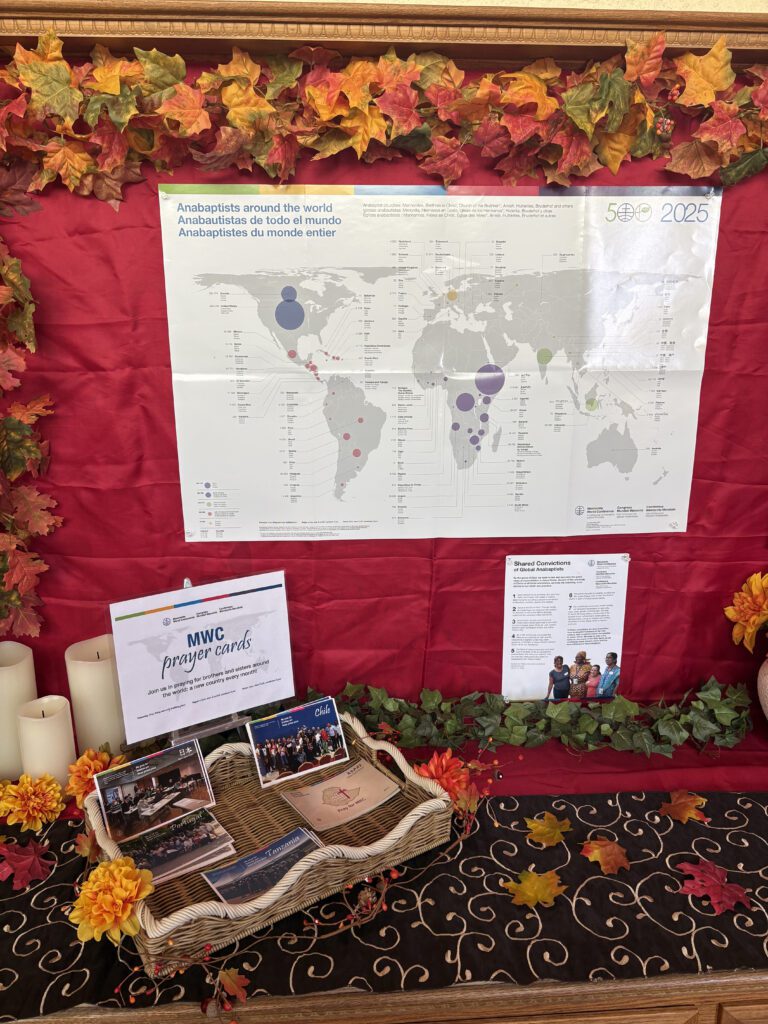
The Shared Convictions of MWC came out of a 13-year process from beginning, through drafts, to approval at the General Council.
Some 34 or more Confessions of Faith had been collected from member churches around the world.
“We were emailing back and forth” – “maybe even by fax!” inserts Larry Miller – “looking for commonalities,” says Nelson Kraybill, who was involved in drafting the document.
“It felt like a spiritual moment to actually see in these documents: these are the things we have in common,” Nelson Kraybill says. “Follow Christ; peacemaking; mission.”
“We took the statement about we are Anabaptist from the top to the bottom,” says Nancy Heisey. “The top says: As part of the one body of Christ at all times and places,… Rather than starting out with: We are Anabaptists, we started out with: the church of Jesus Christ.”
“At the end, as we adopt these: we draw inspiration from Anabaptist forebears of the 16th century. That was a really critical decision,” says Nancy Heisey.
“We intended that beginning and ending to be just as important as the seven points,” says Nelson Kraybill.
The meeting in Pasadena where the General Council approved the Shared Convictions in 2006 was the first one to use the consensus model.
“Nancy (then president) was sitting on the left, Danisa (then vice-president) on the right and one word was still problematic. Jesus Christ incarnate,” remembers Larry Miller.
“The North American delegates were in the back defending the word incarnate, which had been inserted during the General Council meetings in Zimbabwe.
“Joren Basumata was a warm, quiet laughing fellow from India. He didn’t speak much in meetings. But he rose then to say: If you include that word, I can’t use this in India. All the gods in India are incarnate.
“All the blue cards (disagreement) instantly switched to orange (agreement).”
The whole process of how the Shared Convictions came about illustrates how MWC can work together according to the mission of being a global community of faith.
“The Shared Convictions were intended not to replace what churches have already discerned but to affirm what we share together,” says Larry Miller – “what we hold in common,” Nelson Kraybill adds.
“My prayer is that we continue to use them that way and not become a bone of contention,” says Nancy Heisey.
“We shouldn’t be the place where you create a synthesis of something by majority vote, trying to reconcile various opinions. Instead, it’s a place where the gathered body receives their revelation and offers it to the world and sees what happens,” Larry Miller says.
“It’s been astounding to see how broadly the Shared Convictions have been used,” says Larry Miller. “Affirming what we share together has been very meaningful as we try to work out how to be God’s people in the world.”
Fellowship
The global Assembly in Zimbabwe in 2003 was formative in MWC’s mission of facilitating relationships between Anabaptist-related churches worldwide. The country was under dictatorial rule. There was an economic crisis with the host of challenges that come along with hyperinflation. Yet Anabaptists from around the world intended to meet to worship together.
“We had long discussions whether to even go,” said Nancy Heisey.
“We didn’t want to impose more suffering on the church there,” said Larry Miller. “But the Brethren in Christ would say: Where is your faith?”
The BIC Church (BICC) sent a letter to the Netherlands where the Doopsgezind were concerned (as they had been regarding Assembly in Brazil in 1974) about appearing to support a regime by attending.
“It’s not the government that is inviting you; it is the church!” BICC Zimbabwe responded. The Dutch Mennonites came.
Organizers encouraged attendees to bring a small gift of tea or sugar for the hosts. “I’ll never forgot three men from Angolan who had brought bags of dried fish. What an amazing sign of what we want to be for one another,” says Nancy Heisey.
“We were looking at the whole thing from two different worlds,” says Danisa Ndlovu. “From a Zimbabwean African context, we have a saying The tummy of a stranger is as big as the horn of a god. When a stranger comes, there will be communion, fellowship. You don’t say: Why is he coming here to eat the little that I have!”
“The world has its own stuff going out there, but we as a church can still gather and be a church together,” said Danisa Ndlovu. “The Assembly theme, Sharing gifts in suffering and in joy, helped to bring that together. People left with the feeling that it was good to come.”
“That was a foundational experience in our movement toward understanding our global body as a communion,” says Larry Miller.
Unity
Part of MWC’s mission is to relate to other Christian world communions and organizations.
MWC’s first secretary to serve as paid staff Paul Kraybill became involved with the conference of secretaries of Christian world communions. This is a gathering of leaders from organized Christian bodies in the world.
Since then, every MWC general secretary has joined the group. César García and Larry Miller have also been called upon to serve as the group’s chair. “We decided consciously to engage in those spaces. When they call on us, that recognizes a gift from the Mennonite world,” says Larry Miller.
“Part of MWC’s work is to help moments of reconciliation in the ecumenical movement grow, both at level of international and national dialogues and ongoing challenges of getting them out to where people are living and worshipping,” he says.
“You start with a mustard seed,” says Nancy Heisey.
Early seeds of MWC’s 2025 reconciliation with the World Communion of Reformed Churches were planted in 1952 when then president H.S. Bender attended an official event at the Grossmünster.
Another seed was what the Lutherans call “the Mennonite Action” in the Lutheran World Federation (LWF) assembly in Stuttgart, Germany, in 2010. This apology for the repudiation of Anabaptists in the Augsburg Confession was the culmination of a long process.
The president of LWF brought the action to delegates and said: We would like to you approve this action either by standing or kneeling in prayer, Larry Miller remembered.
“Suddenly, everyone one was on their knees or standing. The only ones sitting were Mennonite guests.”
“I couldn’t hold my tears,” says Danisa Ndlovu. “It was incredible to see those people on their knees. It was like electricity, a shock; they all fell down.”
“As that story has moved its way through the ecumenical world, people who study these things have lifted that out as a new form of reception: not only us accepting documents but also receiving each other in our worship,” says Larry Miller.
The worship service in Zurich on 29 May 2025 is a dramatic representation of that “reception” as an experienced unity, not necessarily a unity of agreement. In the Grossmünster on that day, it was not just theologians and church authorities in discussion but ordinary people in worship, in liturgy, in life; Mennonites and Reformed in this place of historic division.
Witness
Growing into being a communion has been accompanied by this care for one another, and learning to find our voice collectively.
“Situations can be diverse, but speaking to the situation is critical. Public words must be well thought; people that see our statement must see integrity in us,” says Danisa Ndlovu. “Hurriedly chosen words can bring more fire into a situation instead of reconciliation.”
“After decades in ecumenical movement, I am dubious of the impact of statements – except perhaps on ourselves. Perhaps they are most effective when there is suffering in some place in our body that we are speaking about and to. There can be impact especially if it is growing out of our own pathos,” says Larry Miller.
When the General Council met in Guatemala in 2000, the African caucus called for a statement about the violence in Eastern DR Congo. Although there were no MWC member churches in that region at the time, “We decided that because so many member churches had a sense of need and engagement with the conflict, we needed to say something,” says Nancy Heisey.
“There was a lot of caution, but I remember saying strongly, we should write the letter,” says Danisa Ndlovu.
A year later, the church in DRC wrote a fraternal letter to church in USA just after 9/11 (the attacks on World Trade Towers in New York City and the Pentagon in Washington).
“That was really significant,” says Nancy Heisey.
As a resident of the USA, she was again touched by a message from the global church just after the USA election in 2024. I want you to know I’m praying for you, wrote a professor at CEMTA (Centro Evangélico Menonita de Teología Asunción) in Paraguay.
Having lived under military dictatorship, “he understands what authoritarianism means for the church, with all the complexities of how Mennonites navigated that,” Nancy Heisey says.
“I don’t know where the world is going, but I think that North Americans – churches – are going to have to tune in a lot more to wisdom from other places if we want to keep being a church.”
“I have appreciated the current use of pastoral letters that call to prayer. I would encourage using that format to address not only our own immediate concerns but also prayer for wisdom to navigate; how we should be thinking about doing; encouraging us to search our hearts about our mission; how we express our peace witness in the face of concrete situations today,” says Nancy Heisey.
“Those calls to prayer go out broadly. People in congregations at an ordinary level may actually listen. It’s striking what comes up in our Online Prayer Hour breakout groups, for example.”
“Part of it is to help our own constituency in terms of ‘what are we saying.’ It gives direction and some form of unifying, rallying together around an issue,” says Danisa Ndlovu.
“It connects to our role as a peace church,” says Nelson Kraybill. “We need to continue to strengthen relationship and bonds of love and fellowship in global Anabaptist communion, always with peacemaking and mission held together.
“If we can continue to strengthen those internal relationships in the global body – theology of salaam/shalom – then each regional part of the church needs to embody that in their area. We stand with them. We pray with them. We have a call to prayer if there’s a concern. It’s the spiritual bond that will have most lasting effect than political statements,” says Nelson Kraybill.
“I don’t think we should be politicizing, but we can be people who are trying to do what their faith calls them to do,” says Nancy Heisey. “I put in every letter I write [to my political representatives] that I am a Mennonite Christian and my people care about this. There is power in being able to say: My world church is calling us to prayer on this issue. As Bishop Charles Nseemani from BICC Zambia said: We can go talk to our leaders, but they should know we are coming as Christians not as partisans.”
“When you say Mennonite, people think peace,” says Danisa Ndlovu. “We are known as an Historic Peace Church. If we use it wisely, it’s a good testimony.”