
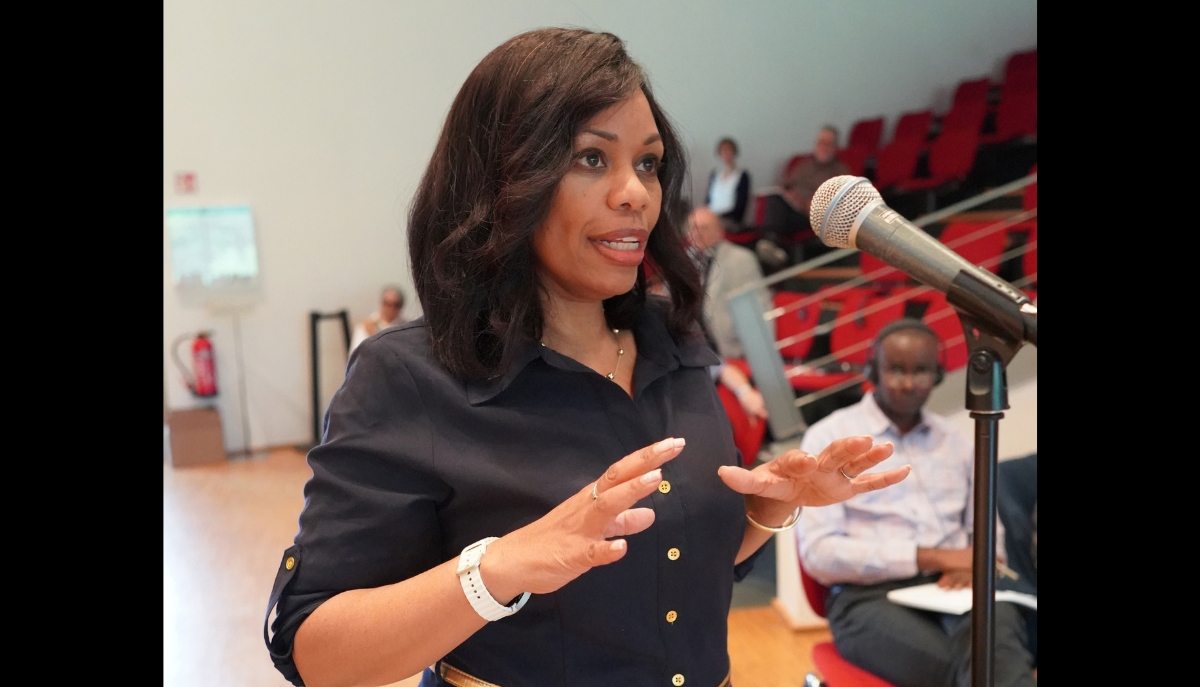
In the 1970s, New York City in the United States was not a natural home to Mennonites. “Most Mennonite churches there were started by people who came from what was then Lancaster and Franconia conferences (today’s LMC and Mosaic),” says Hyacinth Stevens, United States, member of Mennonite World Conference’s Mission Commission.
“They started by engaging with the Black and Hispanic communities through children’s Bible clubs or softball teams, and the children would introduce them to their parents,” says Hyacinth Stevens. Community engagement was at the core of their mission.
During this time, she particularly remembers two white Anabaptist volunteers from Pennsylvania, USA: Irene and Joe, service volunteers from Lancaster serving in the Bronx area of New York City. After many conversations, eventually Irene and Joe invited her mom to a Bible study, where her parents recommitted their lives to Christ.
“This was my first encounter with Anabaptism, when I was at kindergarten,” says Hyacinth Stevens. From thereafter, her faith and church life at King of Glory Tabernacle (then Burnside Mennonite Church) were shaped by Mennonite connections to Lancaster County, Pennsylvania.
Her search for identity as a young adult took her to a Christian & Missionary Alliance college, where she engaged with students from different Christian backgrounds. “It was here that I explored my faith, comparing my Anabaptist convictions with what others believe. Then I realized that while my faith is personal to me, my faith is also about journeying together. A communal experience,” Hyacinth Stevens says.
“The life of Jesus was a story of community. Jesus hung out with people from different walks of life. Jesus came to people’s houses. Jesus grew up in a community. And I feel that the Anabaptist theology and practice in my context is exactly this: Jesus who saw connection with others as key to the whole story,” Hyacinth Stevens continues.
“I identify with the Anabaptist teaching where our individual faith is weaved together. Integrated. The Anabaptist practice gives much room to practice our faith as one community, and I very much relate to this.”
From being in the masses to sitting at the table
The community theme continues throughout into her involvement with Mennonite World Conference too. Hyacinth’s first encounter with MWC was in 2015, during Assembly in Pennsylvania, USA. “I was one of the 8 000, attending with my eyes wandering around, making connections with people who came from different places. I was in the wonder of it all,” Hyacinth Stevens says.
Assembly in Indonesia 2022 was a different experience, “I was being at the table of it all, seeing how people come together and make decisions. The thoughtfulness of the discussions, the processing of each differing opinion, the willingness to learn from each other as we work out our differences, all in the aim of reaching consensus. This process was an inspiration.”
“What I realized was that MWC is a learning organization. We deepen our understanding of our story together. I am deeply inspired and intrigued by this communal story.”
“I think our greatest challenge now is figuring out what peace looks like amongst each other. How can we stay authentic to our differences but still grounded in the same faith where we believe that Christ invites us to reconciliation. And what does look like for Anabaptism.”
“It is challenging, but it does excite me because our greatest role model is Jesus, who knew where he stood on things but was unafraid to go into the world. Jesus revealed himself just as he was into the world.”