

Perspectives (Anabaptism@500 activities)
Panel discussion
Under the title Standing Between the Lines in a World on Fire, voices from five continents gathered on May 29 at the Friedenskirche. On the occasion of the 500th anniversary, they debated a burning issue: how to remain faithful to the Anabaptist heritage of peace and nonviolence in a world torn apart by conflict, injustice and trauma?
In front of a packed audience, the discussion took place in two parts: each speaker shared a testimony, followed by a group discussion. Moderator Judith Wipfler, a Swiss journalist, introduced each speaker, weaving a common thread of vulnerability, courage and commitment.
The science of trauma in the service of peace
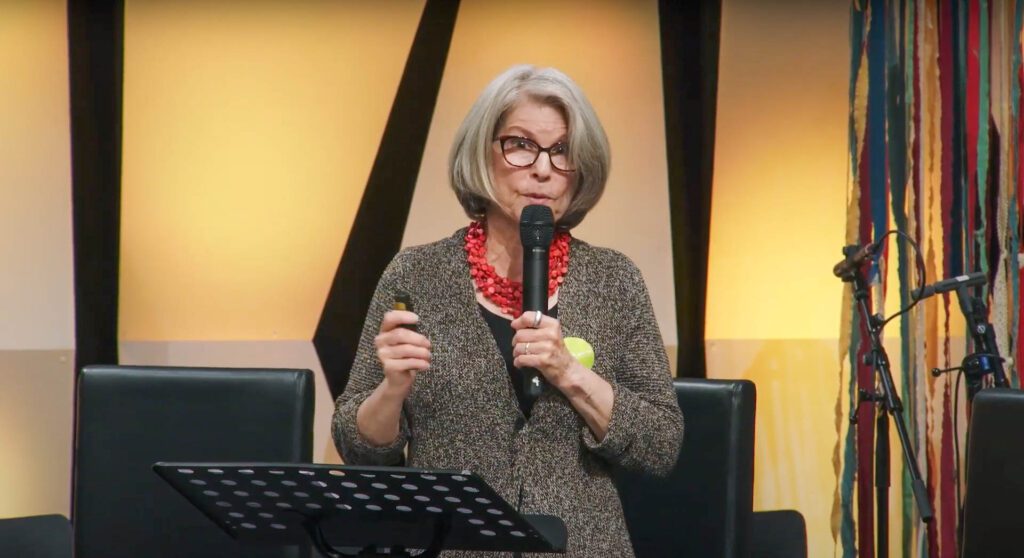
Carolyn Yoder (author of The Little Book of Trauma Healing and creator of the STAR (Strategies for Trauma Awareness and Resilience) program), opened the session.
Coming from the USA, she began by telling the story of a father who was confronted with violence and chose a peaceful response, thereby breaking a destructive cycle.
Drawing on recent advances in neuroscience, she went on to explain that when faced with a threat, the human brain switches into survival mode – flight, fight or freeze – which hinders our ability to regulate our emotions, reason and our connection with others.
But, there are “community antidotes”: singing, worship and solidarity. These practices, rooted in Anabaptist history, enable individuals to re-engage in a process of resilience and healing.
“We must protect our spirits so that we do not pass on the violence we have suffered,” she said emotionally, referencing a father in Gaza, a poignant image of wounded humanity. “When we become aware of our wounds, we can choose not to repeat the suffering.”
Migrants and dignity: walking with those who suffer
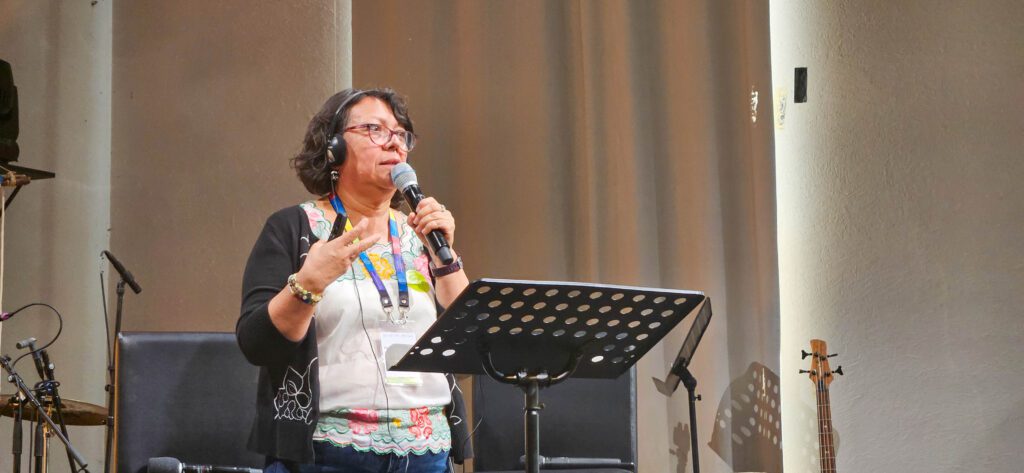
Drawing on Psalm 137, Rebeca González Torres spoke of loss, exile and nostalgia for peaceful times in her work with migrants in Mexico. In this biblical lament, she recognized the feelings of those she accompanies: uprooted, vulnerable, often invisible.
Together with her husband, she founded a “house of peace” near a migrant detention centre near the border with the USA. “We welcome people when they are released, sometimes barefoot, with nothing.” Beyond providing material support, she emphasized the importance of listening: “Sometimes I would make food, but they wouldn’t eat. First, we had to understand their needs.”
Now living in the state of Morelos (close to Mexico City), she continues to support families searching for missing loved ones. Her message is clear: the church has a vocation of accompaniment, of active compassion and must be a place of listening for suffering.
“Even without money, we can walk alongside those who are searching.”
Serving with humility in West Africa
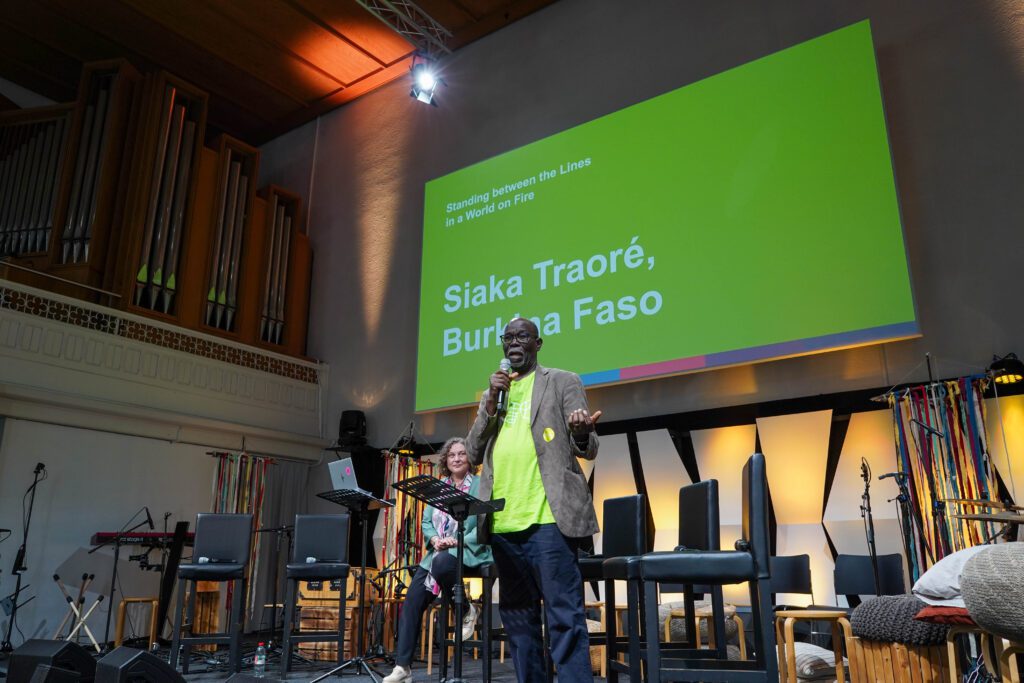
Siaka Traoré from Burkina Faso offered a profound reflection on what it means to be a “mentor” or “encourager” in his context.
As regional representative for the Mennonite World Conference, he is connected to 10 communities spread across several countries in West and Central Africa, bringing together more than 240 000 believers.
In a region marked by political instability, community tensions and linguistic challenges (official languages French, English, Portuguese, in addition to tribal languages), he works to strengthen churches through transparency, humility and brotherhood. “A leader is not there to be served, but to serve,” he reminded the audience, quoting Mark 10:45.
Beyond internal conflicts within churches, he cautions: “Many see the Mennonite World Conference as an NGO. We must remember that it is first and foremost a communion of churches.”
Through his work on the ground, he embodies mediation, unity and peace, emphasizing how mutual encouragement is a powerful motivator in crisis situations.
a mentor/Irma Sulistyorini
conflict and peace/Irma Sulistyorini
Where being a pacifist is an act of faith
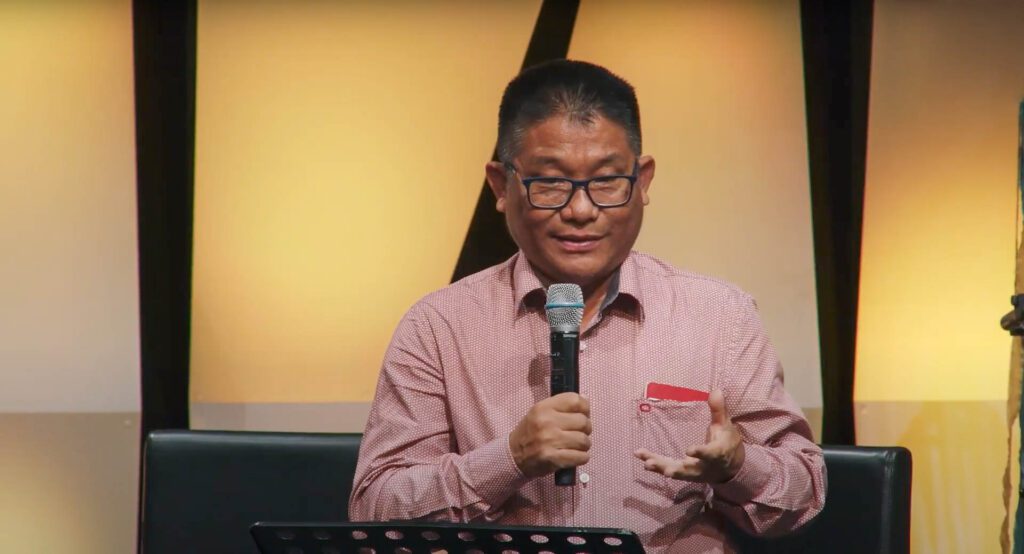
The mere presence of Amos Chin in Zurich was nothing short of a miracle. The pastor in Myanmar had to overcome administrative and political obstacles to leave a country at war. “Myanmar is under military rule. It takes courage to go to church,” he said.
Coming from a Buddhist family, he faced rejection for following Christ: “When I was baptized, I was excluded from my family.”
Today, he accompanies a young Mennonite generation threatened by conscription. Some are arrested, others live in hiding. Despite this, his message remains rooted in nonviolence. “We teach pacifism even in this extreme context.”
His heartfelt cry resonated with the audience: “Why does the world forget Myanmar when it is so mobilized for Ukraine? Our suffering is just as real.”
Active faith in a world of fire
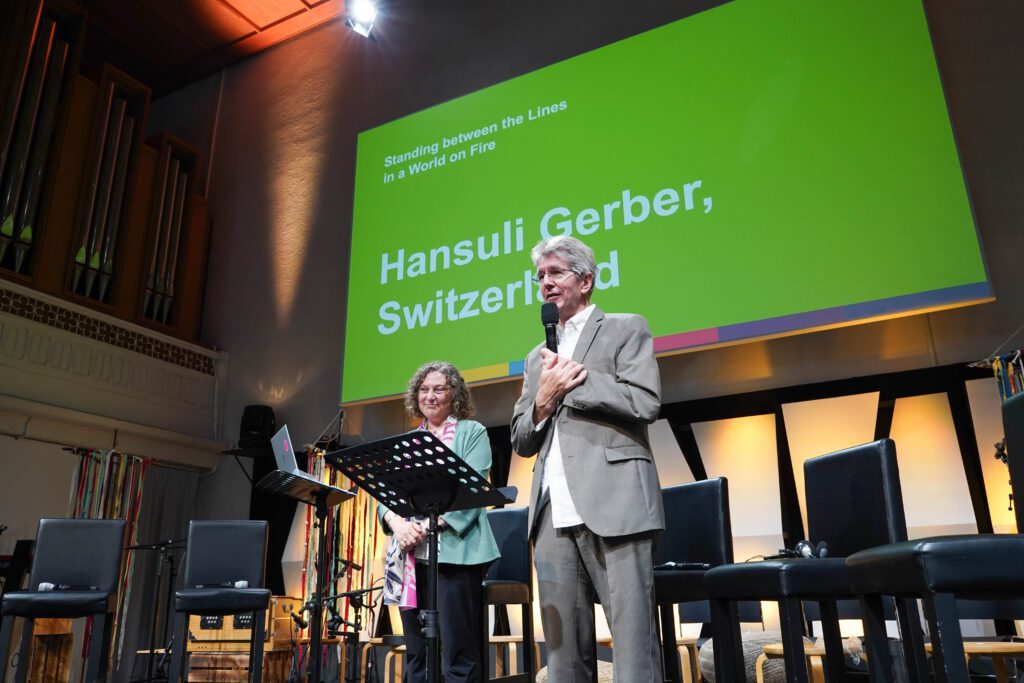
Hans Ueli (John) Gerber, a Mennonite from Switzerland, offered a peaceful but lucid summary. He reminded us that conflicts are part of human life and are not problematic in themselves. What matters is what we do with them.
“Conflict is neutral. Violence, on the other hand, is always destructive,” he said.
Citing the work of Aleksandr Solzhenitsyn and Friedrich Hacker, he urged caution regarding violent solutions: “Violence claims to resolve evil, but it is the evil it claims to resolve.”
He also referred to the frequent confusion between peace as the absence of conflict and peace as a dynamic of justice. Peace, in the Anabaptist tradition, is demanding: it requires truth, courage and community.
“What sustains us is love. But what guides us is humility.”
Discussion
The final discussion provided an opportunity to exchange views.
Amos Chin reiterated the importance of global and equitable solidarity.
Carolyn Yoder advocated for a culture of active nonviolence based on solid research. She pointed out that nonviolent conflicts are resolved on average three times faster than those involving violence.
Rebeca González Torres urged churches to move beyond a purely spiritual stance and engage concretely with people who are suffering. “Often, we just say ‘God bless you,’ but that’s not enough.”
This panel will be remembered for powerfully illustrating how the Anabaptist tradition can continue to provide a prophetic voice in a troubled world.
—Maude Burkhalter is an editor with Alliance Presse, a Swiss publisher of Christian materials, and a member of Église évangélique mennonite Tavannes, Switzerland.
This article first appeared in the newsletter of Konferenz Der Mennoniten Der Schweiz/Conférence Mennonite Suisse.